
Affordable Roof Flashing Repair Near West Palm Beach Tips Costs and Trusted Local Services
A roof can look fine from the street and still be taking on water at the flashing. Around West Palm Beach, that small strip of metal or membrane matters a lot. Wind-driven rain, salt air, intense sun, and tropical storms all test the seams where your roof is most vulnerable.
Roof flashing protects places where the roof changes direction or meets another surface. Think chimneys, vents, skylights, walls, valleys, and roof edges. When flashing fails, water can move under shingles, tile, underlayment, or flat roofing material. The repair may start small, but the damage can spread into decking, fascia, insulation, drywall, and mold-prone areas.
The good news: many flashing problems can be repaired affordably if you catch them early and hire carefully. This guide explains what commonly goes wrong, what affects repair costs, how to budget, and where to look for reliable roof flashing help near West Palm Beach.

Why roof flashing matters so much in South Florida
Flashing is not decorative trim. It is a water-control system.
On a sloped roof, flashing directs water away from openings, joints, and roof transitions. On low-slope and flat roofs, it helps seal edges, walls, drains, vents, and equipment curbs. When it is installed well, water sheds off the roof before it can enter weak points.
Near West Palm Beach, flashing has a harder job than it does in many cooler inland areas. Roofs deal with:
Strong UV exposure that dries out sealants
Heavy summer rain that finds small openings quickly
Wind-driven rain during storm season
Salt air that can speed corrosion on some metals
Heat expansion and contraction that loosens joints over time
Tile, shingle, metal, and flat roof systems that each require different flashing methods
A flashing repair is often less expensive than a major roof repair because it focuses on a specific vulnerable area. That said, the repair must be done correctly. Smearing caulk over a leak may slow water for a short time, but it rarely solves the underlying problem.
Common roof flashing issues and what they can damage
Flashing problems often show up as small interior stains, musty smells, peeling paint, or a drip during heavy rain. The source is not always directly above the stain. Water can travel along rafters or underlayment before it appears inside.
Here are the most common issues local homeowners run into.
Cracked or dried sealant
Sealant around vents, skylights, and wall flashing breaks down under heat and UV light. Once it cracks, water can slip behind the flashing.
A small sealant failure may be a simple repair if the metal or membrane is still in good shape. But if the area has been leaking for a while, the contractor may need to inspect the decking below.
Rusted or corroded metal flashing
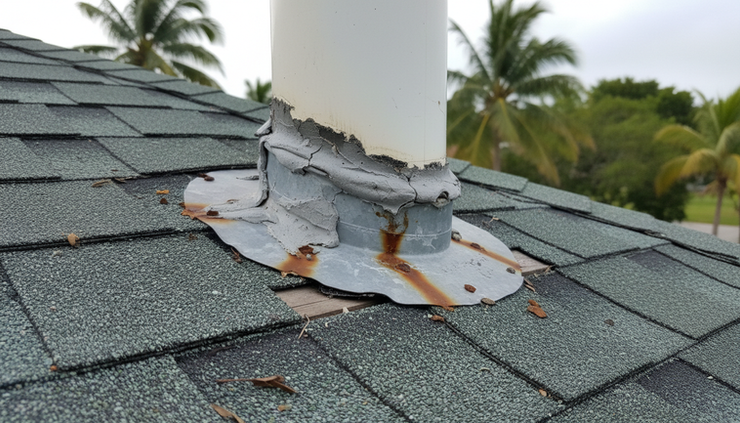
Metal flashing can corrode, especially where different metals touch, fasteners are exposed, or salt air is a factor. Rust holes and pitting allow water through the flashing itself.
Corroded flashing usually needs replacement rather than another coating of sealant. A contractor should match the replacement material to the roof system and nearby metals to reduce future corrosion.
Lifted flashing after wind or poor installation
Flashing must be secured and layered so water flows over it, not behind it. High winds can lift edges. Poor installation can leave gaps, reversed laps, or exposed fasteners.
This is especially important after a storm. If flashing lifts even slightly, rain can enter under the roof covering before a leak becomes visible indoors.
Failed step flashing along walls
Step flashing is used where a sloped roof meets a vertical wall. Each small piece overlaps the next so water drains down and away.
When step flashing is missing, reused incorrectly, or buried behind siding or stucco without proper counterflashing, leaks can be hard to trace. Wall-to-roof joints are one of the most common places for water intrusion.
Leaks around roof penetrations
Plumbing vents, exhaust vents, satellite mounts, and other penetrations need flashing boots or curbs. Rubber boots can crack, metal collars can loosen, and fasteners can back out.
These repairs are often affordable when handled early because the damaged part is small. Waiting can turn a boot replacement into a decking and ceiling repair.
Valley flashing problems
Roof valleys move a high volume of water. If debris collects there, water can back up under shingles or tile. If the valley flashing is damaged or poorly secured, leaks can occur during heavy rain.
Valley repairs can cost more than simple vent flashing work because they often require removing and reinstalling a larger section of roofing.
What influences the cost of flashing repair
There is no single price for roof flashing repair because the work depends on access, roof type, damage level, and material. For planning purposes, small flashing repairs often fall into a lower-cost category than full roof section repairs, but hidden water damage can change the scope.
These factors have the biggest effect on cost.
Cost factor | Why it matters |
Roof type | Tile, shingle, metal, and flat roofs require different labor and materials. Tile repairs may involve careful removal and replacement of surrounding tiles. |
Flashing location | Easy-to-reach vent flashing usually costs less than flashing in a steep valley, around a chimney, or near a wall transition. |
Damage level | Replacing exposed sealant or one boot is simpler than repairing rotted decking, wet insulation, or interior damage. |
Material choice | Aluminum, galvanized steel, copper, stainless steel, lead boots, and membrane flashing vary in cost and service life. |
Access and safety | Steep roofs, multi-story homes, and tight access areas require more time and safety equipment. |
Storm demand | After major storms, contractor schedules fill quickly. Emergency work can cost more than planned maintenance. |
Code and permitting needs | Some repairs may trigger local code requirements, especially if work expands beyond a small repair area. |
A basic repair might involve cleaning the area, removing failed sealant, replacing a boot or short flashing section, fastening it correctly, and sealing it with a compatible product. A larger repair may require removing roof covering, replacing underlayment, installing new flashing, and restoring tile, shingles, or membrane.
To budget well, ask for a written scope that separates:
Inspection or diagnostic fee
Materials
Labor
Disposal or cleanup
Interior damage, if included
Warranty terms
Permit handling, if required
If a contractor gives only a vague lump sum, ask what they plan to remove, replace, seal, and test. A clear scope helps you compare bids fairly.
How to find affordable roof flashing repair near West Palm Beach
Affordable does not mean cheapest. It means the repair solves the leak without unnecessary upsells, rushed workmanship, or repeated service calls.
Use these steps to find cost-effective help.
Start with licensed roofing contractors
In Florida, roofing work should be handled by properly licensed contractors. Before scheduling repair work, check the contractor’s license through the Florida Department of Business and Professional Regulation, often called DBPR. You can also check local licensing requirements through Palm Beach County resources.
A license does not guarantee perfect work, but it is a basic filter. Also ask for proof of insurance. If workers are injured on your property or the repair causes damage, insurance matters.
Look for flashing-specific experience
Not every roof leak is a full roof replacement issue. Ask direct questions:
Do you repair flashing around vents, walls, skylights, chimneys, and valleys?
Do you work on my roof type?
Will you inspect the surrounding underlayment or decking?
Do you use metal flashing, membrane flashing, or both?
What warranty applies to the repair?
For tile roofs common in Palm Beach County, ask how the contractor removes and resets tiles. For flat roofs, ask about compatible membrane materials and how they seal penetrations.
Get at least two written estimates
One estimate may be enough for a clear emergency leak, but two or three bids are better when the situation is not urgent. The lowest bid is not always the best value.
Compare the details, not just the final number. A higher estimate may include replacing damaged underlayment, while a lower one may only reseal the exposed area. Those are not the same repair.
Be cautious after storms
After severe weather, out-of-area roofers may knock on doors or offer quick fixes. Some are legitimate. Some are not. Avoid pressure tactics, large upfront cash payments, and vague contracts.
A reliable contractor should be willing to explain the repair, provide license and insurance information, and put the scope in writing.
Ask about repair options before replacement
If the roof is near the end of its life, replacement may be the smarter long-term choice. But if the roof is otherwise sound, a targeted flashing repair can buy years of service.
Ask the contractor to explain whether the leak is isolated or part of a larger pattern. A good roofer will tell you when a repair is reasonable and when it is only a temporary patch.

Local resources and service options to check first
Because contractor availability changes, avoid choosing based only on a name you see in an ad. Use trusted resources to build a short list, then verify each company yourself.
Good starting points near West Palm Beach include:
Florida DBPR license search
Use it to confirm an active roofing contractor license and check public complaint history.
Palm Beach County contractor licensing resources
Local government resources can help you understand county requirements and verify contractor status.
Florida Roofing and Sheet Metal Contractors Association
This trade association can help you learn what to expect from professional roofing work and may offer contractor search tools or member references.
National Roofing Contractors Association contractor resources
NRCA provides general guidance on choosing roofers and understanding roofing systems.
Better Business Bureau serving Southeast Florida and the Caribbean
BBB profiles can show complaint patterns, business history, and customer feedback.
Manufacturer-certified contractor directories
If your roof uses a specific shingle, tile, metal, or flat roof membrane product, check whether the manufacturer lists trained or certified installers in the area.
For companies that specialize in roof flashing repair, search for local roofing contractors that clearly list services such as:
Roof leak detection
Tile roof repair
Shingle roof flashing repair
Flat roof penetration repair
Chimney and wall flashing repair
Skylight flashing repair
Storm damage roof repair
When you call, describe the suspected flashing area rather than saying only “roof leak.” For example, “There is a leak near a plumbing vent after heavy rain,” or “The stain is below the wall where the garage roof meets the second story.” Specific descriptions help the contractor send the right person and tools.
How to budget without overspending
A flashing repair budget should include more than the visible repair. Water damage can hide under roof covering or inside the attic.
Use this simple planning approach.
Set aside money for diagnosis
Some contractors offer free estimates. Others charge for leak detection, especially when the source is hard to find. A diagnostic fee can be worth it if it prevents guesswork.
Ask whether the fee applies toward the repair if you hire the company.
Plan for a small contingency
Even if the leak looks minor, set aside extra funds for related damage. Rotten wood, broken tiles, damaged underlayment, or wet insulation can add to the final cost.
A good rule is to avoid spending the full budget on the first quoted repair number. Leave room for surprises.
Separate urgent repairs from cosmetic work
Stopping water comes first. Interior repainting, ceiling texture repair, and cosmetic trim work can wait until the roof is confirmed dry.
If money is tight, ask the contractor what must be done now to prevent damage and what can be scheduled later.
Ask about repair warranties
A low price with no warranty may not be a bargain. Ask how long the workmanship warranty lasts and exactly what it covers.
For example, a warranty may cover the repaired flashing area but not unrelated leaks elsewhere on the roof. That is normal, but it should be clear.
Avoid repeated temporary fixes
Repeated caulking can cost more over time than one proper flashing replacement. If you have paid for the same leak more than once, ask for a more complete repair plan.
Regular maintenance keeps flashing repairs affordable
The cheapest flashing repair is often the one you prevent.
South Florida roofs should be checked regularly because weather conditions are demanding. A yearly roof inspection is a smart habit, and another check after a major storm can catch lifted flashing, broken tiles, clogged valleys, or loose vent boots.
You can do a basic visual check from the ground. Do not climb on the roof unless you have safe equipment and experience. Look for:
Stains on soffits or fascia
Loose or missing roof tiles
Lifted shingles
Rust streaks around flashing
Cracked sealant at vents or skylights
Debris collecting in valleys
Water stains on ceilings or attic wood
Musty odors after rain
Keep gutters and valleys clear where safe to do so. Trim branches that scrape the roof. Watch areas around skylights, chimneys, roof vents, and wall transitions after heavy rain.
Inside the home, check the attic during daylight if it is safe and accessible. Light coming through roof penetrations, dark wood stains, or damp insulation may point to a flashing issue.
A small leak during one heavy storm is not something to ignore. Flashing leaks often return, and each rain event can push water deeper into the roof system.

Questions to ask before hiring a roofer
Before approving work, ask clear questions and expect clear answers.
What flashing component failed?
What caused the failure?
Will you remove old sealant or roofing material before repair?
Will you replace any damaged underlayment or decking?
What materials will you use?
Are the materials compatible with my roof system?
Is a permit needed for this repair?
How will you protect nearby tiles, gutters, landscaping, and exterior walls?
What cleanup is included?
What warranty will I receive in writing?
Take photos before and after the repair. Many contractors also provide photos of hidden damage once the roof covering is opened. These images help you understand the work and can be useful for records.
When repair may not be enough
Flashing repair makes sense when the roof is generally in good condition and the leak source is isolated. Replacement or a larger roof project may be more practical when:
Multiple flashing areas are failing
The underlayment is brittle or worn out
Tiles or shingles are breaking across the roof
Leaks keep appearing in different locations
The roof is near the end of its expected service life
Storm damage affected a large section
A trustworthy contractor should not push a full roof replacement for every leak. At the same time, a small repair on a failing roof may only delay the larger issue. Ask for photos and a plain explanation before deciding.
The smartest path to an affordable repair
Affordable roof flashing repair near West Palm Beach starts with early action. Look for signs of water intrusion, schedule a qualified inspection, verify licensing, and compare written scopes before choosing a contractor.
A good repair does more than stop the next drip. It restores the roof’s water path so rain moves away from vulnerable joints, vents, walls, and valleys. That protects the structure beneath the roof and helps control long-term costs.
If you suspect a flashing leak, do not wait for a ceiling stain to grow. Document what you see, call licensed local roofers with flashing repair experience, and ask for a repair plan that explains both the immediate fix and the condition of the surrounding roof. Small, well-timed repairs are usually the ones that save the most money.


Comments